
Rot to Resource
How we're learning to use fungi for more sustainable design

Fungi built the first soils, hold ecosystems together, and now offer practical tools for food, medicine, materials, and pollution control. We've been using them for millennia, and now more weird and wonderful uses are emerging.
What fungi are
Fungi belong to their own kingdom. They don't make food from sunlight, and they don't swallow it as animals do. They grow as fine filaments called hyphae that spread through soil, wood, and decaying matter. Hyphae knit themselves into mycelium, a living web that forms the body of the organism.
Hyphae build this network in two ways: they branch, and they fuse. Branching allows one thread to become many. Fusion, called anastomosis, links separate threads into a continuous system. Before fusion can occur, hyphae must locate one another. They use a chemical attraction process known as homing. This creates a network that connects to itself through repeated acts of contact and stitching. In this way, mycelium grows by recognizing and joining with its own parts. The same capacity also lets it connect with other networks, allowing one fungal system to meet and merge with another. Mushrooms are just the reproductive structures of fungi where spores are produced.

Fungi digest from the outside. They release enzymes that break large molecules into smaller ones that they can absorb. This allows them dismantle lignin in wood and complex hydrocarbons in soil. Few organisms can do this. This ability gives fungi their ecological role as recyclers.
Fossil and molecular evidence place fungi's terrestrial expansion at roughly 450 to 500 million years ago, near the time plants left the oceans. Many scientists argue that fungi prepared the ground by weathering rock into mineral soil, and plants followed and partnered with them.
Most land plants now depend on fungi. Roughly 80 to 90 percent of plant species form mycorrhizal relationships. The plant provides the fungi with sugars it makes through photosynthesis. The fungus gives the plant nutrients it needs and otherwise could not access, including up to 80% of the plant's nitrogen and as much as 100% of its phosphorus needs. Each partner grows better than it could alone.
Mycorrhizal networks link roots across entire forests. Suzanne Simard and colleagues showed that carbon moves through fungal networks from mature trees to seedlings, and from trees in the sun to those in the shade. Other studies later confirmed that fungi redistribute nutrients and stress signals among plants.
Fungi also dominate decomposition. Without them, wood and detritus would pile up. Fungi break down dead plant and animal matter and make the carbon, nitrogen, and other minerals available to plants and other organisms to use for growth.
Merlin Sheldrake writes in Entangled Life: How Fungi Make Our Worlds, Change Our Minds & Shape Our Futures:
"The best estimate suggests that there are between 2.2 and 3.8 million species of fungi in the world—six to ten times the estimated number of plant species. Meaning that a mere 6% of all fungal species have been described. We are only just beginning to understand the intricacies and sophistications of fungal lives."
So if humans have already figured out countless ways of partnering with fungi, how many more might we find if we begin to understand the other 94%?
Humans and fungi
Humans ate wild mushrooms before agriculture, then later learned to grow them. Today, we cultivate species such as Agaricus bisporus (button, cremini, and portabella mushrooms), Pleurotus ostreatus (oyster mushrooms), and Lentinula edodes (shiitake mushrooms) at an industrial scale.

Yeast, a unicellular fungus, drives bread and alcohol fermentation. Saccharomyces cerevisiae converts glucose into ethanol and carbon dioxide. Bread rises because the CO2 inflates the dough. Beer and wine exist because yeast excretes alcohol.
Other fungi create flavor. Aspergillus oryzae produces enzymes that convert rice starch into sugar for sake and soybeans into amino acids for miso and soy sauce. Penicillium roqueforti and Penicillium camemberti ripen cheese by digesting fats and proteins into sharp aromatic compounds.
In 1928, Alexander Fleming noticed that Penicillium mold killed bacteria in a petri dish. Penicillin entered clinical use during World War II and saved millions of lives. Fungi also yield other antibiotics.
Fungi produce cyclosporine, an immunosuppressant that enables organ transplants. They produce lovastatin, the first statin drug used to lower cholesterol. They produce antifungals that kill competing, harmful fungi. These compounds arise from chemical warfare. Fungi defend territory with toxins, and humans harvest the weapons for purposes that serve us.
Farmers now inoculate seeds and soil with mycorrhizal fungi. These treatments increase nutrient uptake and drought tolerance in many crops. Biocontrol fungi such as Beauveria bassiana infect insect pests and replace some chemical pesticides. Compost relies on fungal decomposition to stabilize organic matter into humus. Fungi do not replace nitrogen fertilizer, but they reduce the need for it by improving uptake efficiency. Mycorrhizal fungi increase root surface area. They deliver phosphorus and water from tiny soil pores. They secrete glomalin, a sticky protein that helps soil aggregate. Studies link mycorrhizal networks to higher soil carbon storage and improved drought tolerance. Farmers already use fungal inoculants to stabilize yields under stress.
Industrial fermentation uses fungi to produce citric acid, gluconic acid, and enzymes. Aspergillus niger alone generates most of the world’s citric acid supply for food and cleaning products. Fungal enzymes digest starch in brewing, remove stains in detergents, and soften fibers in textiles. Many of these enzymes now come from genetically optimized fungal strains grown in bioreactors. This fungal economy already operates at scale, running quietly in the background of food processing and chemical supply chains.
Fungi change plants and fruit, too. In a series of experiments, a researcher wanted to know if genetically identical strawberry plants associated with different species of mycorrhizal fungi would produce fruit that tastes different. He ran blind taste tests and found that it did. Some strawberries developed a stronger flavor. Others turned out juicier or sweeter, depending on which fungi lived with their roots. Bumblebees visited the flowers of plants linked to certain fungal species more often than others. Yield also varied. Some fungal partnerships produced more berries, and the fruit’s appearance changed as well. Certain fungi led to berries that looked more attractive, while others did the opposite.
Strawberries are not unique in this sensitivity. Most plants, from small ornamentals to towering forest trees, grow differently depending on the fungal communities they host. Experiments with herbs and vegetables show similar effects. Basil grown with different mycorrhizal strains produced distinct blends of aromatic oils. Some fungi increased the sweetness of tomatoes. Others altered the essential oil composition of fennel, coriander, and mint. In leafy crops such as lettuce, certain fungal partners raised iron levels in pigments. In artichokes, they boosted antioxidant activity. In medicinal plants like St. John’s wort and echinacea, they altered the concentration of pharmacologically active compounds.
What's next for fungi?
A new wave of innovation with fungi is emerging. Research and development are underway on projects using fungi as building materials, clothing, mycelium-based food, and even for electronics.
Some companies now grow mycelium directly as food. They don't wait for mushrooms to form. Instead, they cultivate fungal biomass in tanks or stackable trays and shape it into fibrous textures that resemble meat. Mycelium contains roughly 30 to 50 percent protein by dry weight, depending on species and growth conditions, and the amino acid profile resembles that of animal protein more than that of legumes.
This method of mycelial food cultivation offers speed and resource efficiency. These fungi can be grown vertically in large buildings with little wasted space, no need for lighting, and a closed-loop water system. The New York-based company Ecovative is experimenting with several different food products, including one called MyBacon. Get it? The company Quorn offers several products based on mycelium, from meatless crumbles to ChiQuin. I eat them often, and I think they taste better than meat when seasoned well.

Fungal protein does not need to imitate meat to matter. It doesn't need to fool anyone into thinking it's a steak to be a success. It needs to taste good and offer good nutrition. The key is to displace part of the demand for livestock and industrial monocrops that damage human health and the environment while causing needless suffering.
Packaging and foam replacement
Mycelium can bind plant fibers into solid forms. If you stuff a mold with something like hemp or sawdust, mycelium can be introduced that spreads through the organic matter quickly. In a few days, you can heat up the material in an oven just enough to kill the fungus, leaving a foam-like material that keeps its shape.

This process can produce blocks and shells that replace expanded polystyrene foam for packaging and building materials. It requires little heat to manufacture and can be safely composted at the end of its life. Laboratory tests show compressive strengths comparable to low-density foams, on the order of 0.2 to 0.6 megapascals, depending on fiber and growth conditions.
Production speed limits adoption, though. Plastic can be molded in seconds, whereas mycelium takes days to grow. Moisture also weakens the material, so it needs to be coated or sealed for durability in some applications. Packaging suits this tradeoff because it needs biodegradability more than permanence.
Building materials and textiles
Mycelium composites are being tested as insulation boards, acoustic panels, and interior tiles. These materials trap air like foam and absorb sound like cork. They're made just like the mycelium packaging.

Thermal conductivity measurements fall near 0.04 to 0.06 watts per meter kelvin (R-value of 2.4-3.6), similar to some natural fiber insulations. It has good fire resistance, but moisture can be a challenge, and load-bearing capacity remains low. These mycelium boards do not replace concrete or steel, but rather gypsum board, cork, and mineral wool in niche settings.
Mycelium grows into dense mats under controlled conditions. Tanning and coating turn these mats into leather-like sheets. Fashion brands are starting to use them for shoes, bags, and upholstery. This approach avoids cattle farming and tanning that involves toxic chemicals. It reduces land and water use, but a fully biodegradable fungal leather does not yet exist at commercial scale.

Environmental remediation
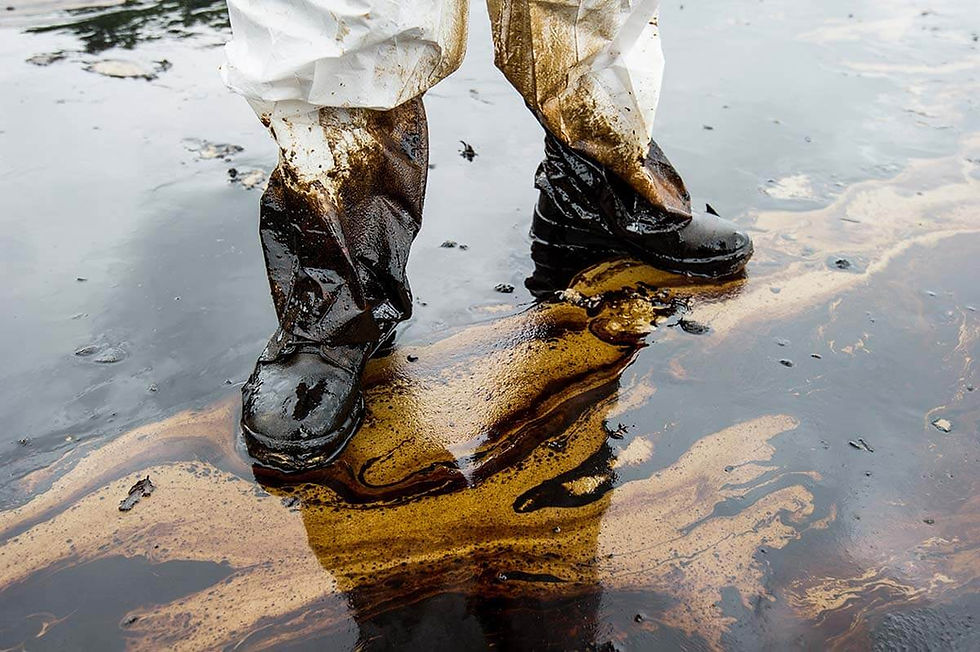
Mycoremediation uses fungi to break down or immobilize pollutants in soil and water. Many fungi digest tough carbon-based molecules that resemble the structure of wood. The same enzymes that let fungi rot logs can also attack petroleum, industrial dyes, and some pesticides. Some fungi even seem to get their energy from ionizing radiation from nuclear waste, as is seen in the ruins of the Chernobyl nuclear plant.
One of the best-known examples comes from field trials using oyster mushrooms to treat oil-contaminated soil. In experiments in Washington State, researchers mixed fungal spawn into diesel-soaked earth. Within weeks, the dark hydrocarbon sludge turned into lighter soil that supported plants and insects. Chemical tests showed sharp reductions in petroleum compounds, while untreated control plots remained toxic. Similar methods now appear in small-scale cleanups at construction sites and fuel storage areas.
Textile wastewater offers another application. Dyes resist conventional treatment because their molecular rings stay stable in water. White rot fungi such as Phanerochaete chrysosporium produce lignin-degrading enzymes that split these rings apart. Several treatment plants in India and China now run fungal reactors alongside bacterial systems to reduce dye concentration before discharge.
Fungi also show promise with explosives. Laboratory and pilot scale studies demonstrate that white rot fungi can degrade TNT and related compounds in contaminated military soils. The process converts the explosive into less toxic nitrogen-containing products rather than simply burying it.
Heavy metals pose a different problem. Fungi cannot destroy elements, but they can bind them. Their cell walls contain chitin and melanin, which adsorb lead, cadmium, and mercury. Some wastewater systems now use fungal biomass as a biological filter to trap these metals before they reach rivers.

Environmental scientist Danielle Stevenson is pioneering mycoremediation techniques to clean up the toxic mess left behind after wildfires claim houses and vehicles in California. The idea is to use fungi and native plants to reduce pollution levels and pull heavy metals out of the ground so that the land can heal and doesn't leach those toxins into our water supply.
Industrial biotechnology and experimental stuff
Fungi already act as chemical factories, and genetic engineering expands what they can do for humans. Scientists are tuning them to produce enzymes, organic acids, and pharmaceutical precursors. Fungal bioreactors operate at room temperature and normal pressure, whereas petrochemical plants operate at high heat and pressure. Biology trades speed for efficiency. This approach will not replace refineries, but it can replace specific steps where enzymes outperform catalysts.
Some researchers are pushing fungi into stranger territory. They're testing mycelium as living sensors. Electrical signals travel through hyphae in response to moisture and chemicals. Teams have built crude circuits that register environmental change and respond to light.
Some people imagine growing habitats in space. NASA funded studies on using fungal binders to turn Martian soil into building blocks. Some propose self-healing walls that regrow cracks.

Fungi help shape our world. Without them, nature does not function, and you do not live. Plants have partnered with fungi pretty much since the beginning of their existence, and humans have partnered with fungi for millennia. Fungi will not replace our current building and manufacturing materials, but they may displace a few of them. As human civilization and progress threaten much of the biosphere we—and all life on earth—depend upon, fungi may help us to achieve more ecologically benign ways of doing things. From food to materials to construction, fungi and human creativity may serve to create things that require less energy, water, and resources, and don't create forever chemicals that pollute our world and harm life for centuries or longer. Almost poetically, fungi will be the ones that break down these mycelium-based products into the building blocks that new generations of living creatures will use to grow.
Resources:
Adamatzky, A., Gandia, A., & Makarov, V. (2020). On electrical spiking of fungi. Biosystems, 193, 104138. https://doi.org/10.1016/j.biosystems.2020.104138
Attias, N., Danai, O., Tarazi, E., & Ezov, N. (2017). Mycelium-based materials for architecture: A review of recent developments. Journal of Bionic Engineering, 14(4), 597–606. https://doi.org/10.1016/S1672-6529(16)60379-3
Brundrett, M. C. (2002). Coevolution of roots and mycorrhizas of land plants. New Phytologist, 154(2), 275–304. https://doi.org/10.1046/j.1469-8137.2002.00397.x
Ecovative. (n.d.). Grow better materials. https://ecovative.com/
Finnigan, T. J. A., Wall, B. T., Wilde, P. J., Stephens, F. B., Taylor, S. L., & Freedman, M. R. (2017). Mycoprotein: The future of nutritious nonmeat protein, a symposium review. Nutrition Bulletin, 42(2), 151–159. https://doi.org/10.1111/nbu.12278
Harms, H., Schlosser, D., & Wick, L. Y. (2011). Untapped potential: Exploiting fungi in bioremediation of hazardous chemicals. Nature Reviews Microbiology, 9(3), 177–192. https://doi.org/10.1038/nrmicro2519
Jones, M., Bhat, T., Kandare, E., Thomas, A., Joseph, P., Dekiwadia, C., Yuen, R. K. K., Wang, C. H., & John, S. (2020). Thermal degradation and fire properties of mycelium composites. Materials & Design, 192, 108789. https://doi.org/10.1016/j.matdes.2020.108789
Pointing, S. B. (2001). Feasibility of bioremediation by white-rot fungi. Applied Microbiology and Biotechnology, 57(1–2), 20–33. https://doi.org/10.1007/s002530100745
Selosse, M.-A., Strullu-Derrien, C., Martin, F. M., Kamoun, S., & Kenrick, P. (2015). Plants, fungi and oomycetes: A 400-million-year affair that shapes the biosphere. Trends in Ecology & Evolution, 30(12), 702–710. https://doi.org/10.1016/j.tree.2015.09.003
Simard, S. W., Perry, D. A., Jones, M. D., Myrold, D. D., Durall, D. M., & Molina, R. (1997). Net transfer of carbon between ectomycorrhizal tree species in the field. Nature, 388(6642), 579–582. https://doi.org/10.1038/41557
Smith, M. L., Bruhn, J. N., & Anderson, J. B. (1992). The fungus Armillaria ostoyae is among the largest and oldest living organisms. Nature, 356(6368), 428–431. https://doi.org/10.1038/356428a0
van der Heijden, M. G. A., Martin, F. M., Selosse, M.-A., & Sanders, I. R. (2015). Mycorrhizal ecology and evolution: The past, the present, and the future. Nature Reviews Microbiology, 13(12), 789–801. https://doi.org/10.1038/nrmicro3562
PBS. (n.d.). Can fungi solve California’s toxic soil problem? https://www.pbs.org/video/can-fungi-solve-californias-toxic-soil-problem-dimahk/
Sheldrake, M. (2020). Entangled life: How fungi make our worlds, change our minds & shape our futures. Random House.
Simard, S. (2021). Finding the mother tree: Discovering the wisdom of the forest. Knopf.
Wohlleben, P. (2016). The hidden life of trees: What they feel, how they communicate—Discoveries from a secret world (J. Billinghurst, Trans.). Greystone Books.


Comments